
A ship chandler supplies vessels with the stores they need during a port call; from food, bonded goods and cabin stores through to technical spares, marine chemicals and safety equipment. A good ships chandler also manages the logistics behind that supply, working with ships’ agents, port authorities and HM Revenue & Customs so that everything reaches the quayside before the vessel sails.
For an operator, agent or port buyer, the chandler is often the difference between a smooth turnaround and a delayed sailing. This guide explains what a ship chandler does, how chandlers work with the people who place orders, and what to look for when choosing one. It draws on the experience of JC Altham, a family-run ship chandler founded in 1856, which supplies vessels and offshore operators at ports across the UK.
What is a ship chandler?
A ship chandler is a specialist supplier that provides a vessel with provisions, stores and equipment while it is in port, usually against a list of requirements sent ahead by the ship or its agent. Ship chandlers are also called ship suppliers or marine suppliers, and their trade is known as ship chandlery.
The word comes from the chandler, historically a maker and seller of candles. Harbour chandlers once sold candles, rope, tar and lamp oil to ships alongside; over time the trade widened to cover almost everything a crew needs between ports.
Today, a ship chandler acts as a single point of supply. Rather than a master or chief engineer chasing a dozen separate suppliers during a short port call, the chandler gathers the order, sources it, deals with any customs requirements and delivers it to the ship in one coordinated drop.
What does a ship chandler supply?
A full-service ship chandler covers both the hotel side of a vessel, feeding and looking after the crew, and the technical side, keeping the ship running safely. The table below shows the main categories and where each sits within JC Altham’s services.
| Category | What it typically covers | JC Altham service |
|---|---|---|
| Provisions | Fresh, chilled and frozen food: meat, poultry, fish, fruit and vegetables, plus vegan, gluten-free and ethnic foods | Provisions |
| Bonded stores | Duty-free alcohol, tobacco and cigarettes for consumption on board, supplied under customs control | Bonded Stores |
| Technical stores | Engine and deck spares, galley equipment, cabin stores, workwear and safety items | Technical Stores |
| Marine chemicals and gases | Water treatment, cleaning and maintenance chemicals, plus industrial and refrigerant gases | Chemical Sales |
| Technical services | Calibration, gas disposal, and fire extinguisher servicing and repair | Technical Services |
| Logistics | Parcel and spares handling, forwarding, customs clearance, storage and delivery to the vessel | Parcel Handling & Storage and Transport |
Not every chandler covers every category. Some specialise in provisions, others in technical stores, so it is worth checking that a supplier can handle the whole order before relying on them. For the fuller picture, see JC Altham’s ship supply services.
How do ship chandlers work with agents and vessel operators?
Most chandlery orders do not come directly from the ship. They arrive through the people who manage a vessel’s port call, and the chandler’s job is to fit around their timetable.
The ship’s agent
The port agent coordinates everything a vessel needs during its call; berth, pilotage, crew changes and supplies. Agents often pass the ship’s requisition to a trusted chandler and expect them to handle the detail, including delivery timing on the quay.
The operator’s purchasing team
Shipping lines and offshore operators frequently buy centrally. Their purchasing teams order on behalf of several vessels, look for consistent pricing and certification, and need a chandler that can supply at more than one port.
Other chandlers and port suppliers
Chandlers also supply each other. A port-based chandler in Southampton or Aberdeen may buy specialist products, such as Wilhelmsen marine chemicals, from a larger supplier rather than holding every line in stock.
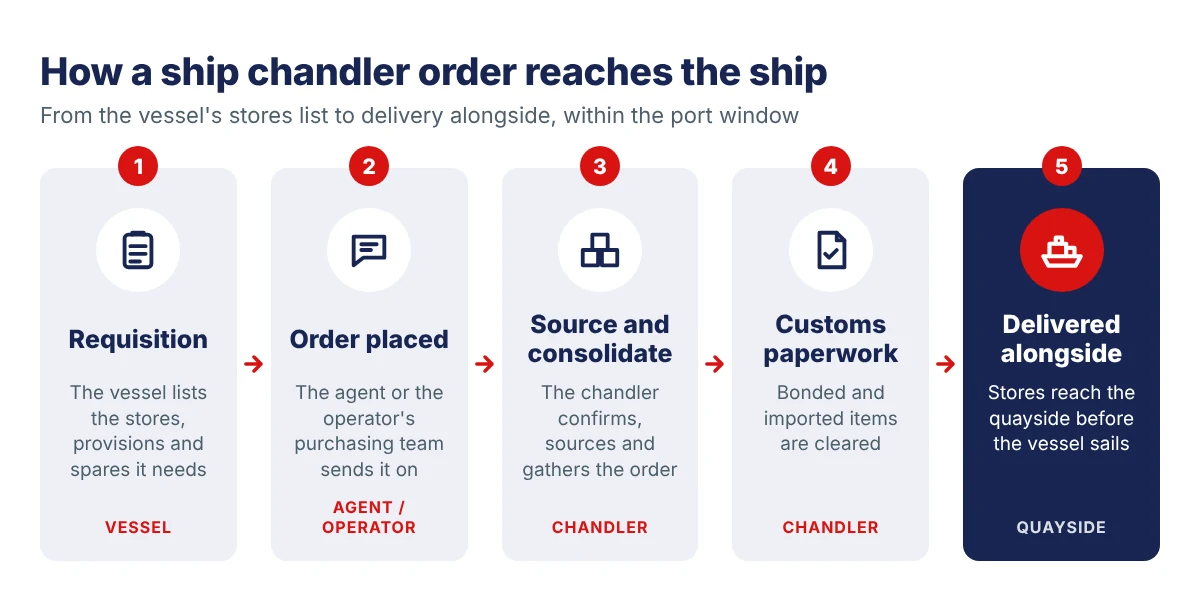
Whoever places the order, the pattern is similar. The chandler receives the requisition, confirms what can be supplied, sources and consolidates the goods, arranges any customs paperwork for bonded or imported items and delivers within the vessel’s port window. Port calls are often short, so a missed delivery can mean a delayed departure or a ship sailing without essential stores.
What should you look for in a ship chandler?
The right ships chandler is the one you do not have to chase. When comparing suppliers, these are the points that matter most in practice:
- Verifiable accreditations. Look for ISSA membership and its quality standard, independent food safety audits such as NSF, and membership of the British Association of Ship Suppliers (BASS).
- Genuine manufacturer relationships. Approved service provider status, such as with Wilhelmsen Ships Service, means genuine products and manufacturer-backed support rather than lookalike alternatives.
- National reach. A chandler should be able to supply the ports you actually use, not only its home port.
- Round-the-clock availability. Vessels arrive at all hours; a 24-hour service keeps supply moving.
- Storage and cold chain. Freezer, chiller and ambient storage protect provisions, and a bonded warehouse is essential for duty-free stores.
- Dangerous goods capability. Marine chemicals and gases need ADR-trained drivers and vehicles insured to carry them.
- Customs knowledge. Bonded stores, spares in transit and export for repair all depend on getting the paperwork right first time.
- People you can call. A named team who knows your vessels will resolve problems faster than a generic order desk.
- Track record. Long-standing customer relationships are the clearest evidence of reliability.
Family-run since 1856: how JC Altham works as a ship chandler
Mrs J C Altham & Sons began in 1856 as a butcher’s shop in Morecambe. Six generations later, the family business is a ship chandler with its head office and warehouse overlooking Heysham Port, supplying provisions and stores to vessels at ports across the UK and to offshore operators in the oil, gas and wind sectors. It is run today by Jane, the founder’s great-great-granddaughter, with her daughter Sarah.

Altham covers each part of the chandlery picture described above:
- A 24-hour ships’ stores service, supporting single deliveries and ongoing supply arrangements.
- A 20,000 sq ft purpose-built warehouse with freezer, chiller and ambient storage, plus a bonded warehouse.
- Temperature-controlled vehicles and a transport operation insured for chemicals and dangerous goods, with ADR-trained drivers and loads from small parcels up to 30 tonnes.
- Wilhelmsen Service Provider status, with marine chemicals, industrial and refrigerant gases, and welding equipment and consumables held in stock.
- ISSA membership since 2009 and the ISSA Quality Standard, BASS membership, and NSF Gold for food safety in storage and distribution.
The ports Altham supplies include Liverpool, Southampton, Portsmouth, Plymouth, Glasgow, Holyhead, Harwich and Sunderland, as well as Heysham itself. Many customer relationships go back years; Seatruck Ferries, for example, has used Altham as a supplier for more than 15 years.
For buyers who already know the product they need, genuine Wilhelmsen and Unitor products can be ordered online through Offshore Supply, Altham’s sister business, which also sets out its online ship stores range. Most customers, though, start with a conversation. You can meet the Altham team or read more about the family’s history.
Quick answers
Is a ship chandler the same as a ship supplier?
Broadly, yes. Ship supplier and marine supplier are often used interchangeably with ship chandler, although chandler usually implies a wider service that includes provisions, bonded stores and delivery to the vessel.
What is the difference between a ship chandler and a ship’s agent?
The agent manages a vessel’s port call on behalf of the owner or operator. The chandler supplies the goods. They work closely together, and the agent is often the one who places the chandler’s order.
Can a ship chandler supply offshore installations as well as ships?
Many can. JC Altham supplies offshore operators in the oil, gas and wind sectors as well as vessels in port.
Talk to a ship chandler who picks up the phone
If you are planning a port call, reviewing suppliers or need stores at short notice, the quickest route is a conversation. Call the JC Altham sales team on 01524 862010, or send an enquiry through the contact page, and we will talk through what your vessel needs.
